Imagine you own a website, but very few people visit it. You start improving your Google rankings, posting on social media, and running online advertisements. Soon, you come across two terms: SEO and digital marketing. Are they the same thing, or do they work differently?
Understanding SEO vs digital marketing can help you choose the right approach for your business. Both strategies help businesses build an online presence, reach potential customers, and generate opportunities. However, they work in different ways.
Let’s understand their differences, benefits, and how they can work together.
What Is SEO?
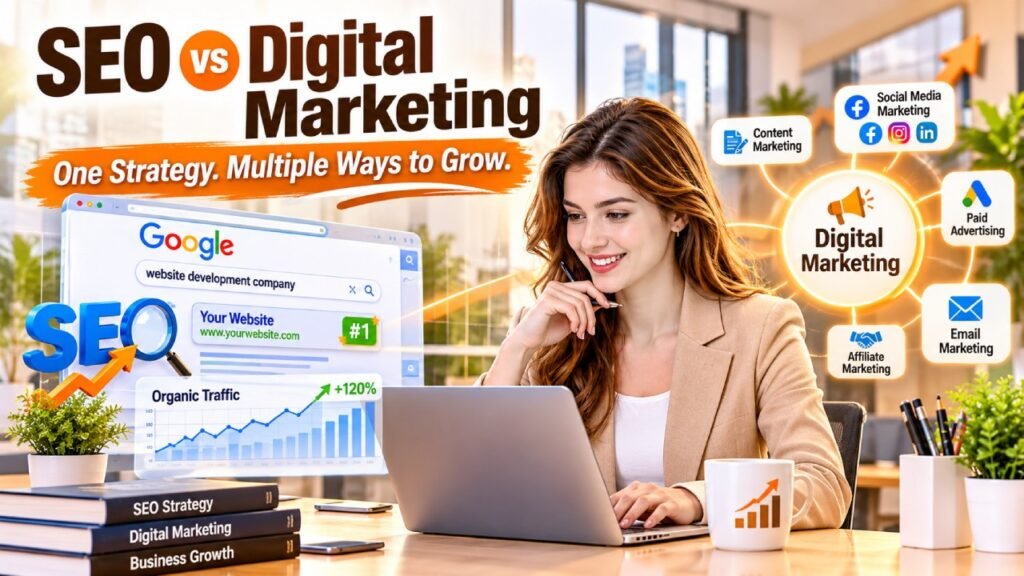
Search Engine Optimization (SEO) is the process of improving a website’s visibility in organic search engine results. It helps search engines understand your website and makes it easier for people to find your pages when they search for relevant information, products, or services.
For example, if someone searches for “best website development company,” SEO helps a relevant website appear in unpaid search results.
SEO mainly focuses on attracting relevant organic traffic without paying for each click.
Common SEO activities include:
- Keyword Research: Finding the search terms your potential customers use.
- On-Page SEO: Improving page titles, headings, content, and internal links.
- Technical SEO: Making websites easier for search engines to crawl and index.
- Off-Page SEO: Building website authority through relevant backlinks and other external signals.
- Content Optimization: Creating useful content that answers visitors’ questions.
SEO is a long-term approach. Results depend on competition, website quality, search demand, and many other factors.
What Is Digital Marketing?
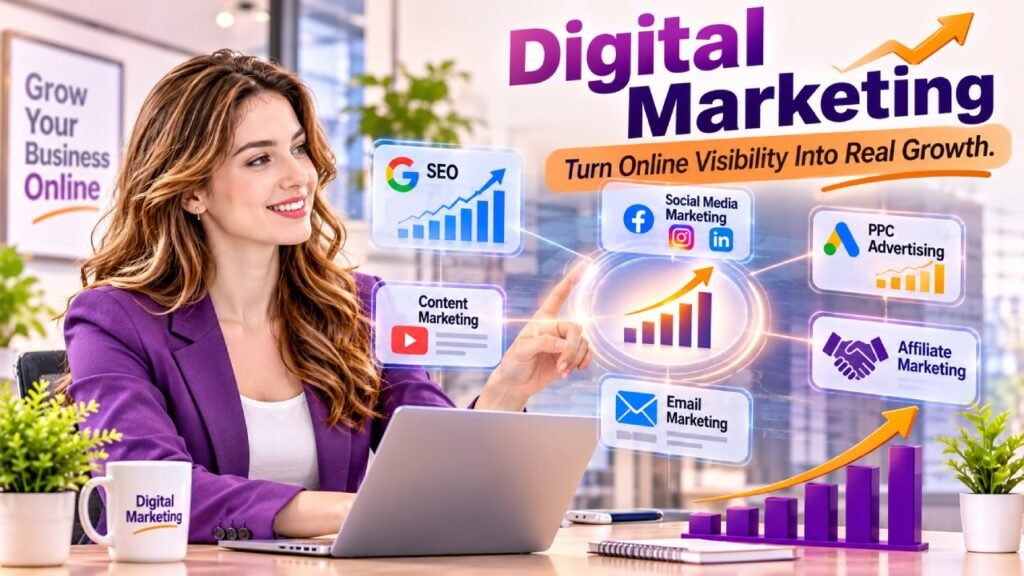
Digital marketing is the broader process of promoting a business, product, or service through digital channels. It helps companies connect with potential customers, build brand awareness, generate leads, and encourage sales.
Unlike SEO, digital marketing does not depend on one particular channel. It combines different online marketing methods to reach people at different stages of their buying journey.
Some common digital marketing channels include:
- SEO: Improving organic visibility on search engines.
- Social Media Marketing: Connecting with audiences through platforms such as Facebook, Instagram, and LinkedIn.
- Pay-Per-Click Advertising (PPC): Running paid advertisements on search engines and other platforms.
- Email Marketing: Sending useful updates, offers, and promotional messages to subscribers.
- Content Marketing: Publishing blogs, videos, guides, and other helpful resources.
- Affiliate Marketing: Working with partners who promote products or services.
Businesses can select different channels depending on their audience, budget, and marketing goals.
SEO vs Digital Marketing: What Are the Main Differences?
The biggest difference is their scope. SEO is a specific marketing technique focused on organic search visibility, whereas digital marketing includes multiple channels and promotional strategies.
Here is a simple comparison:
| Comparison | SEO | Digital Marketing |
| Meaning | Search engine optimization | Promotion through digital channels |
| Main focus | Organic search visibility | Overall online growth |
| Channels | Search engines | Search, social media, email, ads, etc. |
| Traffic | Mainly organic search traffic | Organic, paid, referral, and other traffic |
| Cost | Requires time, resources, and expertise | Costs depend on selected channels |
| Results | Generally a long-term approach | Can include short- and long-term results |
| Main goal | Improve search visibility | Reach, engage, and convert audiences |
For example, publishing an SEO-optimized blog can help attract visitors from Google. Sharing that blog on social media and promoting it through email are additional digital marketing activities.
Both approaches can support the same business goal
How SEO Fits Into a Digital Marketing Strategy
SEO is not separate from digital marketing. It is one of its important components.
Think of digital marketing as a complete plan with different channels working together. SEO helps attract people who are actively searching for information, while other channels help businesses reach and engage audiences in different ways.
For example, a small business can use:
- SEO to attract organic visitors from search engines.
- Social media to share updates and connect with potential customers.
- Content marketing to answer customer questions and build trust.
- Email marketing to maintain relationships with interested customers.
- Paid advertising to reach selected audiences through sponsored campaigns.
When these marketing channels support the same goals, a business can create a more consistent online presence.
SEO vs Digital Marketing: Which Is Better for Your Business?
There is no single answer because both serve different purposes. The right choice depends on what you want to achieve and how quickly you need to reach your audience.
SEO may be a good starting point if:
- You want to improve your website’s Google visibility.
- Your customers regularly search for your products or services online.
- You want to build a long-term source of organic traffic.
- You are ready to invest time in website and content improvements.
A broader digital marketing strategy may be suitable if:
- You want to promote your business across multiple platforms.
- You need to build brand awareness on social media.
- You want to combine organic and paid promotional methods.
- You want to connect with customers through different marketing channels.
For many small businesses and startups, starting with SEO and useful content can be a practical approach. Additional channels can be introduced as business goals and resources grow.
Can SEO and Digital Marketing Work Together?
Yes. In fact, combining SEO with other digital marketing activities can make your overall marketing strategy more effective.
Consider a business that provides web design services. It can publish helpful blogs to attract organic search traffic, share those articles on LinkedIn and Facebook, and use email campaigns to stay connected with interested prospects.
Each channel has a different role, but they all support the same business objectives.
Here are a few practical ways to combine them:
- Create SEO-friendly website pages and blog posts.
- Share useful content on relevant social media platforms.
- Use keyword research to understand customer search intent.
- Build an email list to maintain relationships with potential customers.
- Track website traffic, leads, and campaign performance.
- Improve your strategy based on actual results.
You do not need to use every channel immediately. Start with the methods that best match your audience and available resources.
Final Thoughts on SEO vs Digital Marketing
Understanding SEO vs digital marketing makes it easier to plan your business growth. SEO focuses on improving organic search visibility, while digital marketing brings together different channels to promote your business online.
Neither approach needs to compete with the other. SEO is an important part of digital marketing, and both can work together to attract relevant audiences and create business opportunities.
Our recommendation: If you have a business website, start by building a strong SEO foundation with useful content, proper website optimization, and relevant keywords. Then expand into social media, email marketing, or paid advertising based on your goals.
A balanced strategy can help your business build visibility, connect with potential customers, and grow its online presence over time.
Related Posts:
10 Top Website Performance Tools
How to Improve Google Rankings
Frequently Asked Questions
No. SEO focuses on improving organic search visibility, while digital marketing includes SEO, social media, email marketing, paid advertising, and other promotional channels.
Yes. SEO is one of the main components of digital marketing. It helps businesses attract relevant visitors through unpaid search engine results.
It depends on the business goals. SEO is useful for building long-term organic visibility, while a broader digital marketing strategy can help businesses reach customers through multiple channels.
Yes. You can work on SEO independently by optimizing your website, researching keywords, and publishing useful content. However, combining SEO with other marketing channels can support broader business goals.