SEO and PPC can both help your business reach people who are searching online, but they work in different ways. SEO builds organic visibility over time, while PPC uses paid advertising to bring targeted visitors to your website.
Imagine you own a web development company. You want more people to discover your services, request quotes, and become customers. Should you invest in SEO, run Google Ads, or use both? The answer depends on your budget, business goals, and how quickly you need results.
What Is SEO?
Search engine optimization (SEO) is the process of improving your website so it can appear more prominently in organic search results. These are the unpaid listings that search engines show when people search for information, products, or services.
SEO focuses on making your website useful, accessible, and relevant to your audience. It can involve improving content, researching keywords, fixing technical issues, earning relevant backlinks, and organizing your website structure.
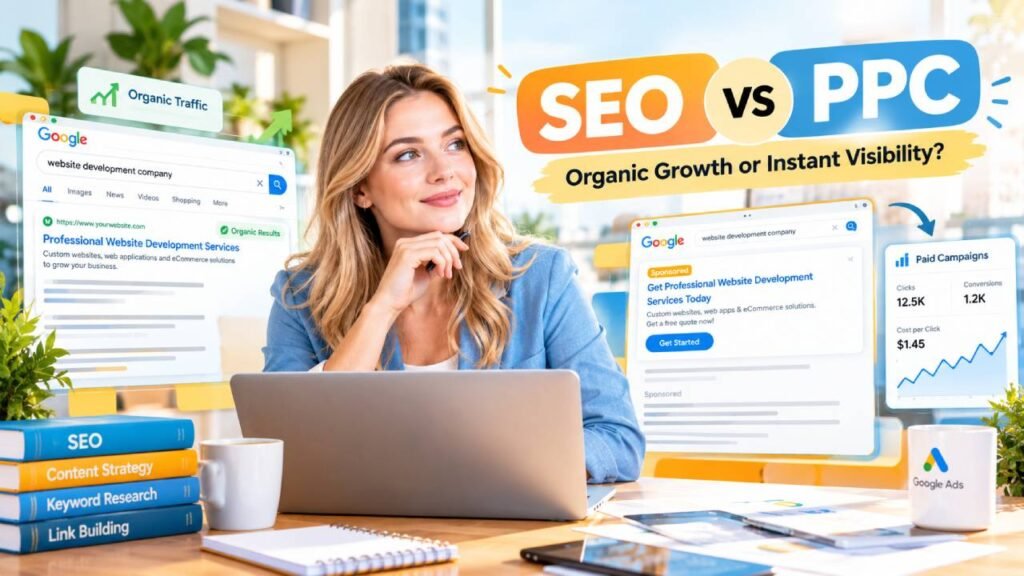
For example, if someone searches for “website development company,” a well-optimized service page may appear in the organic results. If the visitor clicks your listing, you generally do not pay a fee for that individual organic click.
Common SEO activities include:
- Creating useful content around relevant search terms.
- Improving page titles, headings, and meta descriptions.
- Making pages mobile-friendly and improving loading speed.
- Fixing crawling, indexing, and technical website issues.
- Building relevant internal links and earning quality backlinks.
- Monitoring organic traffic, rankings, and conversions.
SEO is generally a long-term strategy. Results depend on competition, your website’s condition, content quality, and other factors. Rankings are never guaranteed.
What Is PPC?
Pay-per-click (PPC) is an online advertising model in which advertisers pay when users click their ads in campaigns that use cost-per-click pricing. Google Ads is a common platform for paid search advertising.
Unlike SEO, PPC allows businesses to bid for advertising placements and target audiences based on factors such as search terms, location, and campaign settings.
For example, a web development company could run an ad for “affordable website development services” and target potential customers in the United States. When the campaign is eligible, the ad may appear in a sponsored position on the search results page.
Common PPC activities include:
- Researching keywords with commercial intent.
- Writing relevant ad copy and creating campaigns.
- Setting budgets, bids, and location targeting.
- Building landing pages that encourage enquiries or purchases.
- Tracking clicks, leads, sales, and advertising costs.
- Testing campaigns and adjusting performance based on data.
PPC can start generating visibility soon after a campaign is approved and begins running. However, traffic depends on your budget, competition, ad quality, targeting, and other campaign factors.
SEO vs PPC: What Are the Main Differences?
The main difference between SEO and PPC is how visibility is earned. SEO aims to improve unpaid search visibility through activities such as content optimization, keyword research, and technical SEO, while PPC uses paid advertisements to reach potential customers.
| Factor | SEO | PPC |
| Traffic source | Organic search results | Paid advertisements |
| Cost model | Investment in content, expertise, tools, and website improvements | Ad spend, often charged per click for search campaigns |
| Time to visibility | Usually takes time to build | Can begin after a campaign launches and is approved |
| Traffic duration | May continue while pages remain relevant and visible | Paid traffic generally stops when ads stop running |
| Control | Less direct control over rankings | More control over budget, targeting, and ad messaging |
| Best suited for | Long-term visibility and organic growth | Time-sensitive campaigns and targeted promotion |
| Measurement | Organic traffic, rankings, leads, and conversions | Ad clicks, cost per lead, conversions, and return on ad spend |
Neither approach guarantees sales or leads. The right choice depends on your business model, audience, resources, and objectives.
SEO vs PPC: Which Costs More?
There is no universal answer because costs depend on your industry, competition, website, and goals. SEO requires resources to create content, improve your website, and maintain performance. PPC requires an advertising budget and may also involve campaign management and landing page work.
With SEO, you generally do not pay search engines for each organic click. However, SEO is not free: your team or agency still invests time, expertise, and resources.
With PPC, you can set campaign budgets, but the cost of clicks varies. Competitive keywords can require higher bids, and a click does not guarantee a sale or enquiry.
To compare the two fairly, look beyond traffic numbers. Measure how much you spend to generate a qualified lead or paying customer.
For example, if an SEO page attracts visitors who regularly request quotes, evaluate the resources invested in that page against the leads and sales it generates. For PPC, compare ad spend and management costs with the revenue or qualified leads produced.
Organic Search vs Paid Ads: Which Delivers Faster Results?
PPC usually offers a faster way to gain visibility because eligible ads can appear after campaigns are approved and launched. SEO often takes longer because search engines need to discover, process, and evaluate your pages, and you must compete with other relevant results.
PPC can be useful when you need to promote a seasonal offer, launch a service, or test demand for a new product. You can adjust your campaign budget and targeting as results come in.
SEO is useful when you want to build a lasting presence for searches related to your products, services, and expertise. Helpful articles and well-optimized service pages may continue attracting visitors without requiring payment for every click.
Keep in mind that neither timeline is fixed. PPC performance can be weak at launch, and SEO improvements can take months or longer to produce meaningful results.
Pros and Cons of SEO
SEO can support long-term business growth by helping potential customers discover your website through relevant searches.
Benefits of SEO
- Long-term potential: Useful pages can continue attracting organic traffic over time.
- No charge per organic click: You do not pay a search engine for each click on an organic listing.
- Audience trust: Some users prefer organic results when researching a business or solution.
- Content value: Helpful articles can answer questions and introduce people to your services.
- Broader visibility: A strong website can attract visitors across many relevant search queries.
Limitations of SEO
- It takes time: Building visibility often requires consistent effort.
- Competition can be high: Established websites may be difficult to compete with.
- Ongoing work is needed: Content, technical health, and search performance need monitoring.
- Rankings can change: Search algorithms, competitors, and user needs can affect visibility.
- SEO is a good option for businesses willing to invest in consistent improvements rather than expecting instant results.
Pros and Cons of PPC
PPC gives businesses a way to promote specific offers and reach selected audiences through advertising platforms.
Benefits of PPC
- Fast visibility: Campaigns can begin reaching people soon after launch and approval.
- Budget control: You can set spending limits and adjust campaign budgets.
- Targeted reach: Ads can be tailored to selected locations, audiences, and search terms.
- Measurable results: Campaigns can track clicks, leads, purchases, and costs.
- Flexible testing: You can test ad messages, offers, and landing pages.
Limitations of PPC
- Ongoing advertising costs: Clicks and conversions require budget.
- No guaranteed sales: Visitors may leave without taking action.
- Competitive bidding: Popular keywords can become expensive.
- Continuous management: Poor targeting or weak landing pages can waste spend.
- Traffic depends on campaigns: Paid visibility generally declines when advertising stops.
PPC can be effective when you have a clear offer, a defined audience, and a way to measure whether your spending produces business results.
Should You Choose SEO or PPC?
Choose SEO if your goal is to build organic visibility, publish helpful content, and attract relevant visitors over time. It is especially useful for businesses that can invest consistently in their website and want to reach people at different stages of the buying journey.
Choose PPC if you need to promote a time-sensitive offer, generate traffic quickly, or test which keywords and messages attract potential customers. It works best when you have a clear budget and a plan to track leads or sales.
Consider your situation:
- New business with a limited budget: Start with essential website SEO and focus on a small number of high-value pages. Use PPC selectively if you can measure the return.
- Business launching a new service: Use PPC to test demand while building SEO content around the service.
- Established business seeking steady growth: Invest in SEO and use PPC for priority services, competitive searches, or specific campaigns.
- Online store with seasonal promotions: PPC can support short-term campaigns, while SEO can help product and category pages attract organic visitors throughout the year.
Your decision should be based on the outcome you need, not simply on which channel seems more popular.
Why Use SEO and PPC Together?
SEO and PPC are not competing strategies that require you to choose only one. Used together, they can provide a more flexible approach to digital marketing.
PPC can help you test search terms, offers, and landing pages. The results may reveal which messages attract clicks or conversions, giving you useful ideas for your SEO content. SEO can build organic visibility for relevant topics while paid campaigns support immediate priorities.
A combined approach can also help your business appear in both paid and organic sections for relevant searches. However, paying for ads does not improve your organic rankings directly.
For example, a digital marketing agency could optimize its SEO services page while running a PPC campaign for a high-priority service. The team could measure leads from both channels and adjust investment according to performance.
Start with clear goals, reliable conversion tracking, and a realistic budget. You do not need to invest equally in both channels. Allocate resources according to your current needs and what the data shows.
How to Measure SEO and PPC Performance
Track results that connect to business goals instead of focusing only on clicks or rankings.
For SEO, monitor organic clicks, impressions, relevant keyword visibility, engagement, qualified leads, and conversions. Google Search Console can help you understand how your website performs in Google Search.
For PPC, monitor impressions, clicks, click-through rate, average cost per click, conversion rate, cost per lead, and return on ad spend where relevant. Google Ads reporting can help you understand how campaigns perform against your goals.
Use analytics and conversion tracking carefully so you can compare the quality and business value of visitors from each channel. A large amount of traffic is not useful if it does not reach the right audience or support your business objectives.
Conclusion
SEO vs PPC comes down to your goals, budget, and timeline. SEO helps build organic visibility over time, while PPC offers a way to promote your business through paid advertising and reach potential customers sooner.
For most businesses, the strongest approach is to build a sound SEO foundation and use PPC where fast visibility or campaign testing is important. If your budget is limited, prioritize the activities that address your most important business needs, then expand as you learn what generates qualified leads and sales.
Frequently Asked Questions
Q1. Is SEO better than PPC for small businesses?
SEO can be valuable for long-term growth, while PPC can help a small business gain visibility quickly. The best option depends on the budget, competition, urgency, and ability to measure results.
Q2. How long does SEO take compared with PPC?
PPC can start generating visibility after campaign approval and launch. SEO usually takes longer to build meaningful organic visibility, and the timeline varies by website and competition.
Q3. Does PPC improve organic search rankings?
No. Buying search ads does not directly improve organic rankings. Paid advertising and organic search operate separately.
Q4. Can I use SEO and PPC at the same time?
Yes. Many businesses use SEO to build organic visibility and PPC to support immediate campaigns, test offers, and reach targeted audiences.
Q5. Which is cheaper: SEO or PPC?
Neither is always cheaper. SEO requires ongoing work and investment, while PPC requires ad spend and campaign management. Compare the cost per qualified lead or customer to understand which is more effective for your business.
Q6. What is the difference between PPC and paid search?
PPC describes an advertising pricing model in which an advertiser pays per click. Paid search refers to advertisements shown in search engine results. Many paid search campaigns use PPC pricing, although PPC can also be used in other advertising placements.